Housing Ecologies
The Arverne Urban Renewal Area on the Rockaway Peninsula had remained largely undeveloped since its clearance in the late 1960s. When the New York City Department of Housing Preservation and Development (HPD) issued a request for proposals for new housing on approximately 100 acres, the Architectural League of New York commissioned design teams to explore alternatives to the development approach envisioned by the city.
Housing Ecologies was developed through this initiative in collaboration with Columbia University’s Graduate School of Architecture, Planning and Preservation. Marble Fairbanks, Michael Bell Architecture, and Mark Rakatansky Studio each designed a different sector of the site, investigating how housing could respond to the peninsula’s fragile coastal ecology, surrounding communities, and history of urban renewal.
Marble Fairbanks proposed a higher-density neighborhood of approximately 28 units per acre, organized into bands of housing connecting the existing community to the beach. Streets, pedestrian passages, and shared outdoor spaces establish connections across the development while responding to the peninsula’s landscape.
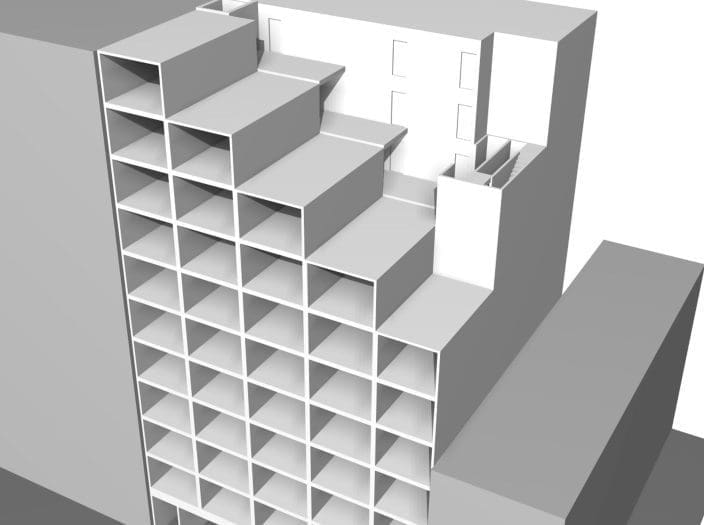
The housing system was designed to accommodate change over time. Prefabricated concrete frames and interchangeable wall panels allow residences to expand or contract as household needs evolve. Openings between units introduce daylight, ventilation, and opportunities for interaction among neighbors.
Housing Ecologies offered an alternative vision for Arverne, challenging conventional approaches to residential development through a closer relationship between housing, community, and the coastal environment.

Location
Far Rockaway, Queens, NY
Client
Arverne by the Sea
Project Type
Design Proposal
Year
2001
MFA Design Team
Scott Marble, Karen Fairbanks, Jake Nishimura, Lars Fischer, Todd Rouhe, Benjamin Hummitzsch, Maya Galbis, Laya Massague
Marble Fairbanks was part of the Columbia University project team led by Michael Bell and including Michael Bell Architecture and Mark Rakatansky Studio. The three teams developed independent proposals for separate sections of the site while working collaboratively to develop strategies for housing at this site.